Both get quoted as an annual percentage, and that is where the similarity ends.
Stake a token and you still have that token. More of it, in fact. Put two tokens in a pool and the pool keeps changing how much of each you have, based on what the market does.
One pays you for locking capital up. The other pays you for quoting a market. This guide works a quarter of both in numbers and covers the structure that tries to do both at once. By the end you can tell which one fits the tokens you need to keep.
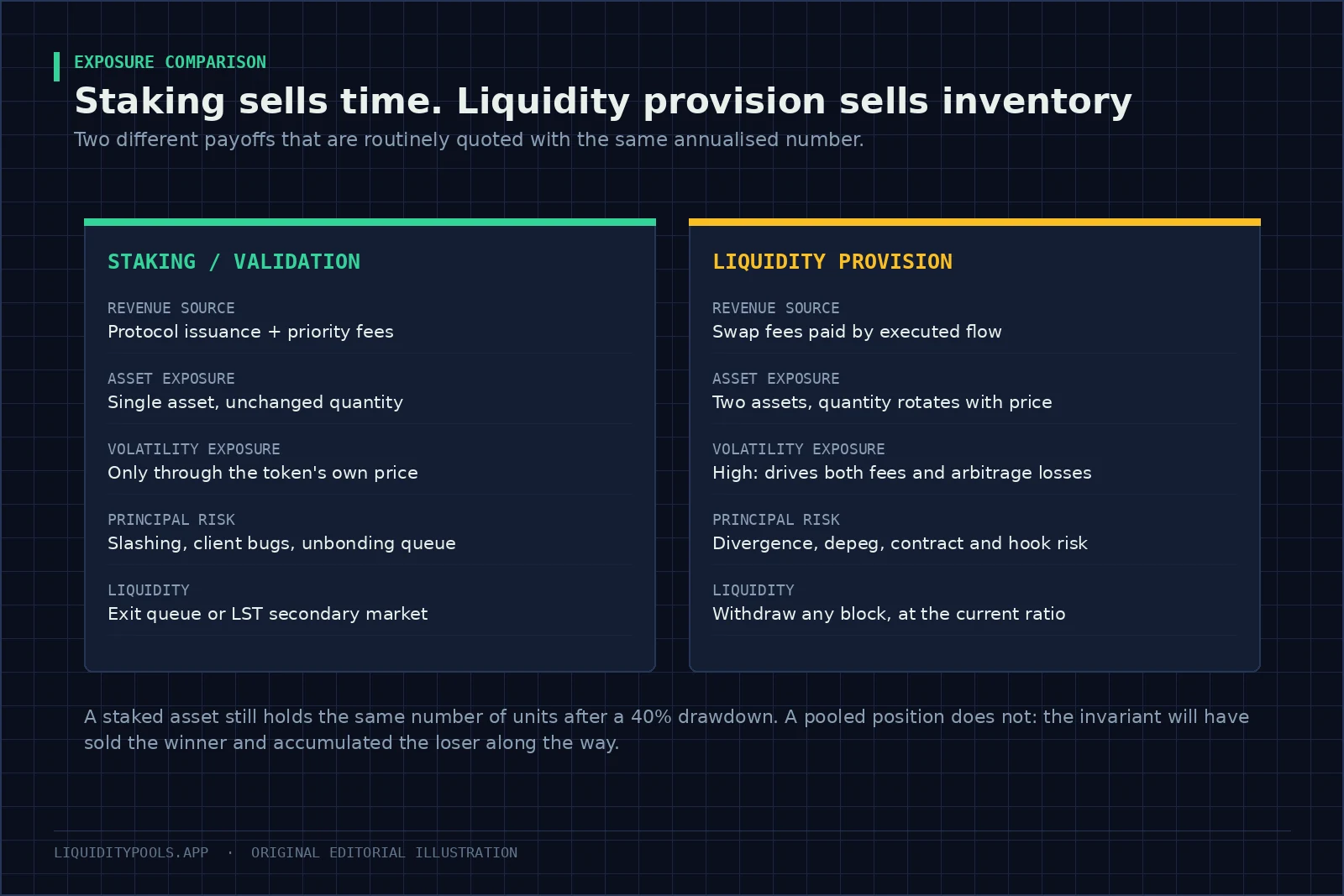
Key point: A treasury that has to hold a fixed number of tokens simply cannot supply them to a two-sided pool. The pool will change that number, and no fee income makes the mandate compliant. It is the clearest case of the exposure mattering more than the yield.
What each one pays you for
Staking commits capital to running a network. On Ethereum, validators earn newly issued ETH for doing their duties[1], plus the priority fees users attach to transactions in blocks they propose[4]. That return depends on how many people are staking and how busy the chain is, not on any price. Your balance, counted in ETH, grows unless your validator is penalised or slashed — forcibly removed with part of its stake burned[1].
A pool commits two tokens to a contract that quotes both sides of a market all day. You get paid the fee on each swap that runs through your money[5]. The position is short volatility: it accumulates whatever is falling and sells whatever is rising. That gap against holding is impermanent loss — how far the pool position trails keeping the same tokens in your wallet. See Impermanent Loss Explained.
Neither is more sophisticated. One is payment for locking up capital, the other is payment for making a market.
Side by side
| Staking | A liquidity pool | |
|---|---|---|
| What you commit | One token | Two, in a required ratio |
| Who pays you | New issuance and transaction fees | Traders, per swap |
| Your token count over time | Goes up, unless penalised | Rotates with the relative price |
| Does volatility matter | Only through the token’s own price | Yes. It drives your fees and what arbitrage takes[8] |
| What can go wrong | Penalties, client failure, exit queues | Divergence, faster traders, contract risk |
| Getting out | An exit queue, or sell the receipt | Any block, at whatever you hold then |
| Predictability | High | Low, and it changes with conditions |
| What to compare against | Holding the token unstaked | Holding both tokens untouched |
Leaving a validator means joining an exit queue whose length depends on network demand[2], which is one reason people who need flexibility hold a liquid staking token instead.
The last row is where most comparisons fall apart. Staking gets judged against holding the same token, which is simple. A pool has to be judged against holding the basket, and that benchmark moves.
A quarter of each, in numbers
$50,000 deployed. Over the quarter, ETH rises 40% and the dollar stays where it is.
Staked ETH at 3.2% a year: your balance grows about 0.8% in ETH terms. Value tracks ETH exactly, plus that bit, minus whatever the staking service charges.
ETH and dollars in a 0.05% pool: you started evenly split and the pool sold ETH the whole way up. Against holding, a full-range position is about 1.4% behind before fees. A narrow band that converted completely is further behind.
Fee income depends on turnover. If the pool trades half its value every day, a full-range position earns about 2.3% over a 91-day quarter, gross. Where Uniswap’s protocol fee is switched on for a 0.05% pool, providers keep 0.0375% of each trade, so about 1.7%[9]. A narrower band earns several times that for as long as the price stays inside it.
Two conclusions:
- In a trending market the pool can earn more in fees and still deliver less, because it sold the asset that ran. Studies of real Uniswap v3 positions find that returns vary widely[7].
- In a flat, busy quarter the ranking reverses, because fees accumulate while the divergence stays near zero.
See LP Fees vs Impermanent Loss.
Doing both at once
Supplying a liquid staking token against ETH is the common way to hold both exposures. The token is a receipt for staked ETH and its rewards, issued by a staking pool[3]. It earns staking yield while sitting in a pool that earns fees on a pair designed to trade near a fixed ratio.
Three risks come with it:
- The receipt can trade below what it is worth. Market price can slip below redemption value during market stress, after a validator incident, or while the exit queue is long[2].
- The curve makes that worse. A flat stable curve keeps buying the dislocating token at near-par until the balances are badly skewed, so you end up concentrated in the weaker side at exactly the wrong moment[6].
- Three contracts, not one. The staking protocol, the receipt token and the pool all have to keep working, and the staking pool’s operators charge a fee[3].
This is reasonable when the pair really is tightly coupled and you understand that the bad case converts you into the receipt at the worst possible time. See Stablecoin Liquidity Pools.
Where farming sits
Farming is not a third thing. It is a wrapper around either of the first two.
A staked token can go into something that pays extra rewards. A pool share can too. Either way you add a token exposure and at least one more contract, without changing what the underlying position actually does.
So evaluate the base position first and treat the rewards as a separate line. See Yield Farming Explained.
That ordering matters because the rewards are the part most likely to end. Strip them away and a staking position still secures a network and earns issuance. A pool position still earns fees if there is flow. A position that only works with rewards attached depends on a programme someone else can stop.
Which to use
Stake when:
- You need to hold a fixed quantity of one token.
- Predictable income matters more than maximising it.
- You will not be watching a position.
Supply a pool when:
- You are genuinely happy holding either token in the pair, at any ratio.
- The pair trades a lot relative to how much it moves.
- You will actually measure the result against holding, and act on it.
Do both, with separate jobs, when you hold enough to split. Keep the tokens you need in a fixed quantity staked. Put only the part you are genuinely indifferent about into a pool, and judge that part against holding on its own, not against the staking rate.
Do neither when the only reason you are considering it is a rate you have not taken apart.
Before you commit
- Write down your benchmark before you enter, not after.
- For staking: check the exit and withdrawal terms, who runs the validators, any penalty history, and the fee.
- For a pool: work out the divergence hurdle and confirm fees plausibly clear it.
- Confirm you would hold either token at 100% weight.
- Check you can actually get out, including the secondary market for any receipt token.
- Model the gas at your size, for the attention each option needs.
- Review quarterly, not weekly. Both are noisy over short windows.
These are complements, not competitors. What they are not is interchangeable, and one annualised number will never tell you which belongs where.
Where to go next
Quantify the pool side with the impermanent loss calculator and the liquidity pool fee and APR calculator. Add the reward layer in Liquidity Mining vs Yield Farming vs Staking, and work the whole thing in Is Providing Liquidity Profitable?.
References
- Proof-of-stake rewards and penalties (ethereum.org)
- Staking withdrawals (ethereum.org)
- Liquid & pooled staking (ethereum.org)
- Ethereum gas and fees: technical overview (ethereum.org)
- Uniswap v3 Core (Adams et al., 2021)
- StableSwap - efficient mechanism for Stablecoin liquidity (Egorov, 2019)
- Risks and Returns of Uniswap V3 Liquidity Providers (Heimbach et al., 2022)
- Automated Market Making and Loss-Versus-Rebalancing (Milionis et al., 2022)
- Fees (Uniswap Developers Documentation)
Frequently asked questions
What is the difference between staking and providing liquidity?
Staking commits a single asset to secure a network and pays new issuance plus a share of transaction fees; your token count grows with rewards unless the validator is penalised. Providing liquidity commits two assets to a pricing rule that continuously rebalances them, so your token quantities change with the market and the return depends on how prices move.
Is staking safer than a liquidity pool?
The risks are different rather than strictly ranked. Staking carries slashing, client and exit-queue risk but no divergence. Liquidity provision carries divergence, losses to better-informed traders and contract risk, but allows exit in any block. Which is safer depends on which risk you can absorb.
Can you do both with the same assets?
Indirectly, through liquid staking tokens. Staking the asset produces a receipt token that can then be supplied to a pool, which stacks staking yield with fee income and adds the peg risk of the receipt against the base asset plus the contract risk of the staking protocol.
Which pays more, staking or liquidity provision?
Staking yields are usually lower and far more predictable. Liquidity provision can pay considerably more on high-turnover pairs and can also produce a net loss against holding. Comparing the headline rates without adjusting for divergence and volatility is not a meaningful comparison.
Continue in this track
This is guide 11 of 14 in Foundations.
Next: TVL Explained: What Total Value Locked Can—and Cannot—Tell You →
Previous: ← Lending Pool vs Liquidity Pool: Two Different Instruments
See the full track sequence, or browse all 59 guides.